YOUR PRESCRIPTION
Understanding your eye prescription helps you make informed decisions about your prescription safety eyewear.

Reading Your Script
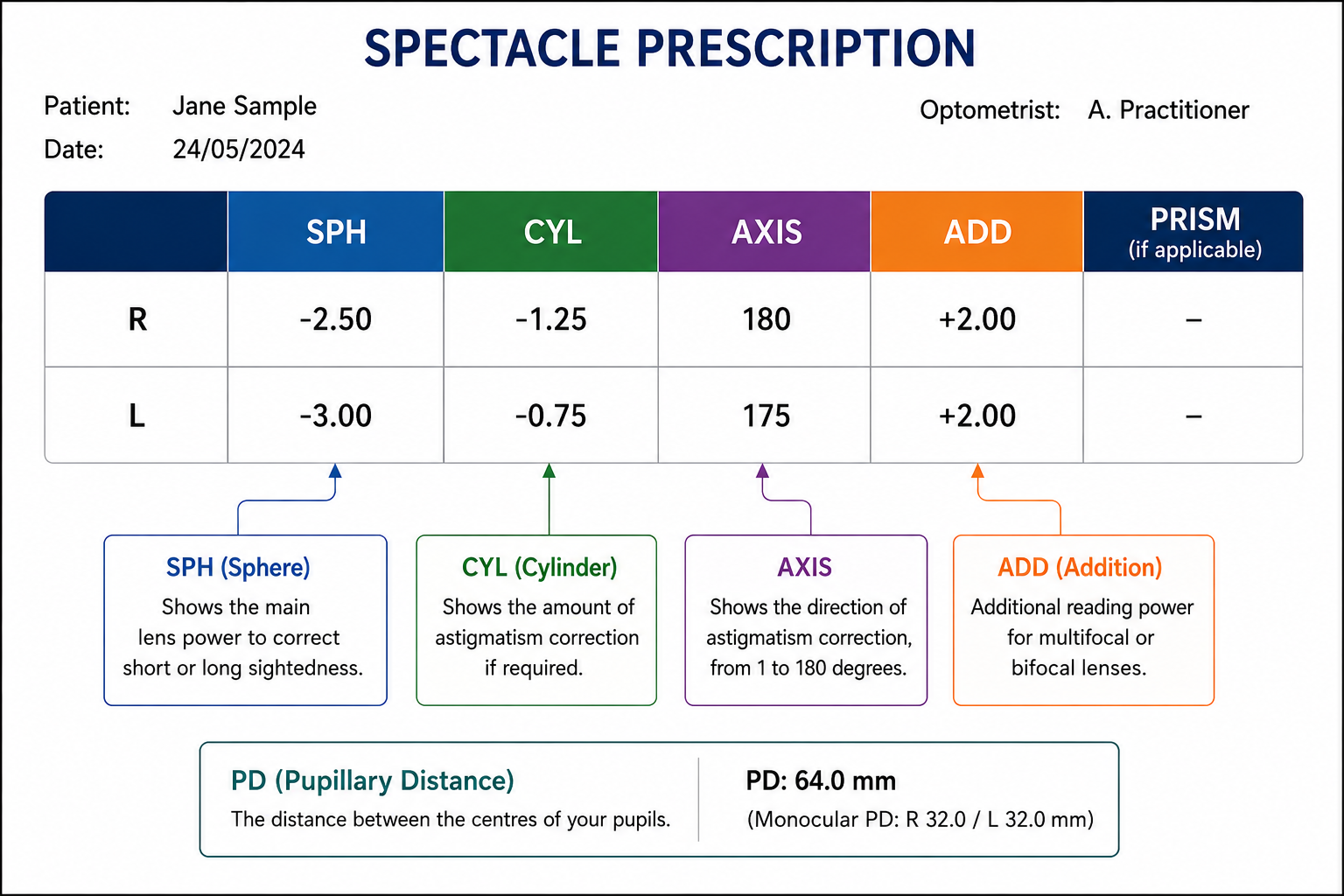
Your prescription is listed separately for each eye (R + L) because they often need different lens strengths. Your optometrist measures each eye individually to ensure you receive the clearest, most comfortable vision.
This is the main power required to correct your vision. It can be either a minus value (-) or a plus value (+). Sometimes the power will show Plano or 0.00, meaning no correction is needed for that part of the prescription. Generally, (+) means long sighted (trouble seeing up close) and (-) means short sighted (trouble seeing in the distance).
This is for correcting astigmatism and will nearly always show as a minus (-).
If this is left blank, there is no correction needed as no astigmatism is present.
Indicates the angle (in degrees from 1 to 180) for your astigmatism correction.
This will be blank if there is no Cylinder.
If additional magnifying power is required for reading and other close up tasks, it will be shown as an ADD value. An Add is used in bifocal and multifocal (progressive) lenses to provide clear near vision.
This is the distance between the centres of your pupils, measured in millimetres. It is used to correctly position your lenses for clear and comfortable vision. It's not always on your prescription, but essential for ordering.
Prescription Example
FAQ's About Your Optical Prescription
Need Assistance?
CALL US
Speak directly with one of our specialists. We're available Monday to Friday, 9am-5pm to answer your questions and help you find the right solution.
CONTACT CUSTOMER SUPPORT
Have a question or need help with an order? Our support team is here to assist you every step of the way get a response within 24 hours.
ORDER FOR YOUR TEAM
We supply to companies and individual workers across Australia and New Zealand. We work closely with you to understand your business needs and provide tailored solutions.